
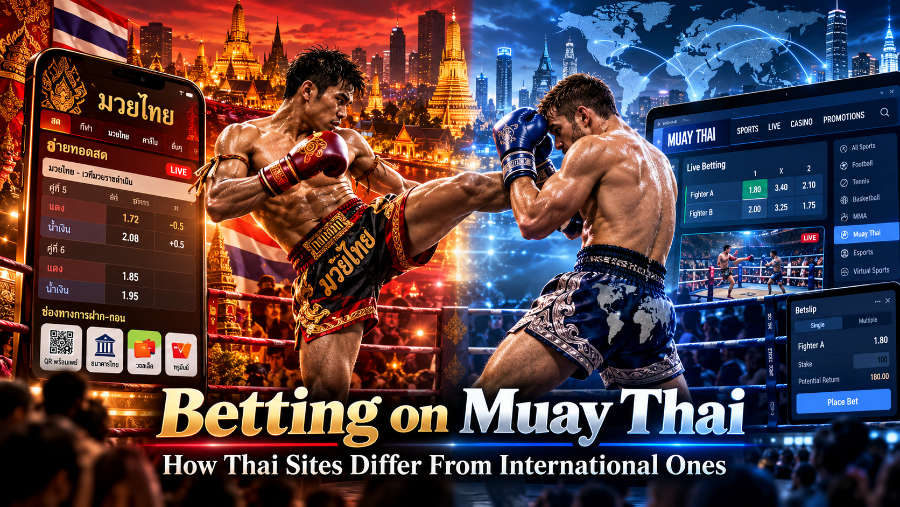
You’ve lost more on Muay Thai than on any other sport, and you don’t fully know why. Maybe it was the favorite who faded in round four. Maybe it was the knockdown you priced wrong because you didn’t understand what the corner was telling the fighter. Or maybe you sat in a Bangkok stand, watched a hand signal you misread, and paid for the most expensive lesson of your betting career. Most international bettors approach Muay Thai the way they approach a UFC card — decimal odds, a pre-set line, one click before the bell. That approach is exactly why the edge never shows up. The real market, the one that has priced this sport for a century, operates somewhere else entirely: in the stands, in cash, in hand signals, and in the weigh-in room. This article explains how the Thai system actually works, how international sites price the same fights, where the two diverge, and what each difference means for your bankroll. I’ve spent years covering the Bangkok stadiums and the international sportsbooks that follow them, and the gap between what a Thai bookmaker knows at the weigh-in and what an algorithm knows at 9 a.m. in London is where most Muay Thai betting mistakes are born.
Background: Gambling in a Country Where Gambling Is Mostly Illegal
To understand Thai Muay Thai betting, you first have to understand the paradox it lives inside. Gambling is largely illegal in Thailand — no casinos, no card rooms. Muay Thai at licensed stadiums (Lumpinee, Rajadamnern, Omnoi, Channel 7) is the major exception, a carve-out that reflects how deeply embedded the sport is in Thai cultural identity.
That exception produced the Golden Era. Gamblers were the majority of ticket buyers at traditional Bangkok stadiums, and their money funded fighter purses, stadium operations, and promotional events. More subtly, the betting ecosystem shaped how the fights themselves looked:
-
The slow first round — odds are being set during round one, so a mistake immediately shifts the market against you. Fighters start cautiously to keep the line as even as possible.
-
The quiet fifth round — if you’ve done enough to win, why risk it? Gamblers on your side tell your corner to protect the lead.
-
Corner advice from the stands — in razor-close fights, it’s usually the gamblers who can tell you who’s winning. They know the scoring better than almost anyone in the building.
The cast of characters is fixed and old: the Kha Yai (big legs) who set the odds, the Sian Muay (professional gamblers) who work the designated sections, the Chao Mue (bookmakers) who facilitate bets and sometimes run live odds commentary for subscribers, and the Nak Muay (fighters) whose modest purses are supplemented by gambler tips — called “injections” — for standout performances.
How Thai Stadium Betting Actually Works
Here’s the system from the inside, because almost everything about it is invisible to a first-time viewer.
Lines are set in the weigh-in room, not by software. The Kha Yai — or their representatives — attend weigh-ins personally. They check whether a fighter made weight cleanly or cut aggressively, whether the cut is showing in the eyes, whether there’s any sign of injury or illness. That intelligence goes directly into the opening odds before any public betting begins. No model, no spreadsheet. A human assessment of a human body, made in person.
Betting opens at the wai kru and moves every round. Once opening odds exist, bets are placed and modified throughout the fight, round by round, as momentum shifts. Odds in a single fight can range from 1:1 in an evenly matched bout to 1:120 in a heavily favored contest. Typical wagers run 1,000 to 100,000 baht, with marquee fights seeing individual bets up to 250,000 baht.
The market speaks in hand signals. Palm down means the favorite; palm up means the underdog; extended fingers indicate the odds level; color indicates the corner. Rapid movement means urgency — the line is moving and the bet needs to be locked in now. Because a misread signal can trigger a real financial dispute, everyone involved has to be fluent in the language. Errors happen, and fights between gamblers over misunderstood signals have occasionally broken out in the stands.
Fighters have a direct stake in the outcome. The tip system means a dramatic comeback or a convincing finish can earn a fighter substantially more than the purse alone. That incentive — plus the fact that gamblers advise corners between rounds — is why traditional stadium Muay Thai rewards so much tactical intelligence.
The modern shift is real. Lumpinee has banned gambling entirely under its new management, Rajadamnern doesn’t permit it at its Saturday World Series events, and ONE Championship operates completely outside the stadium ecosystem. The slow tactical rounds that gambling culture produced are increasingly absent from the entertainment format. Both versions of the sport are real; understanding both requires understanding where the system came from.
How International Muay Thai Betting Sites Work
International platforms price the same sport with entirely different machinery.
-
Decimal odds, account-based deposits — cards, e-wallets, and increasingly crypto, with no cash and no stand.
-
Pre-set lines built from data models — record, camp, style matchups, and historical performance drive the opening price, usually hours or days before the fight, with no weigh-in intelligence.
-
Expanded markets — method of finish, knockdown yes/no, round-by-round, fighter props, and live in-play trading with dynamically adjusted odds.
-
Global coverage — ONE Championship, international cards, and overseas Thai events, not just Bangkok.
-
Promotions, cash-outs, and regulated licensing — consumer protections that don’t exist in the stand.
This is where platforms like LAVA90 sit: an international-style operator that carries Muay Thai markets alongside its broader sportsbook, with decimal pricing, live in-play action, and account-based deposits. If you’ve only ever bet Muay Thai from a phone, you’ve been operating inside this second system your whole time — which is precisely why the Thai system looks alien to you.
Head-to-Head: Thai Stadium vs. International Sites
|
Dimension |
Thai stadium system |
International sites |
|
Odds format |
Thai-style fractional (1:1 to 1:120) |
Decimal |
|
Line setting |
Human intelligence: weigh-in, condition, weight-cut |
Statistical models on record and style |
|
Timing |
Live, round-by-round, in-venue |
Pre-set lines plus in-play adjustment |
|
Market depth |
Essentially winner/underdog |
Expanded props, knockdown, method, rounds |
|
Payments |
Cash |
Cards, e-wallets, crypto |
|
Access |
Locals and insiders |
Anyone, anywhere |
|
Culture |
Public, social, physical |
Private, digital |
|
Liquidity |
Thin, relationship-driven |
Deep, institutionally backed |
Why the Differences Matter
For bettors: edge lives where information lives. The Thai system prices in-person intelligence — condition, cut, corner behavior — that no international model captures. The international system prices global events and expanded markets the stand never touches. Knowing which fight you’re actually pricing, and with which information set, is most of the game. If you’re betting internationally, choose a platform where the Muay Thai market is genuinely listed and liquid rather than a thin afterthought — that’s the practical case for using a dedicated operator like LAVA90 for the international side of your activity, while treating anything you learn about the Thai ecosystem as information, not opportunity.
For fans: the signals, the pacing, the corner conversations — none of it makes sense without context. Once you know the first round is being priced and the fifth round is being protected, traditional Muay Thai stops looking slow and starts looking disciplined.
For the sport: gambling created the best matchmaking in the sport’s history, because a predictable fight is an uninteresting market. Its removal from modern venues is changing the style of competition itself — toward aggression and knockouts, away from patient tactics.
Risks and Integrity in Both Worlds
Be clear-eyed about both ecosystems. The Thai system’s enormous stakes produced documented corruption: match-fixing, referee influence, and — most disturbingly — cases of fighters poisoned before bouts, some of them by their own gym owners, who had bet against them. That corruption, combined with the mid-1990s financial crisis, helped end the Golden Era. The international system carries its own risks: promo terms that quietly erode value, margin differences between sportsbooks, and the general discipline questions of any cash-based activity. Treat both with the same seriousness — verify markets, understand the terms, and bet only what you can afford to lose.
Conclusion
Two ecosystems, one sport. The Thai system is physical, cash-driven, and priced by human intelligence gathered in the weigh-in room; the international system is digital, account-based, and priced by models that have never met the fighter. Each has distinct economics, culture, and incentives — and the future is a hybrid, with Thai fighters going global while international platforms like LAVA90 expand their Muay Thai markets. But understanding the Thai system remains the key to understanding traditional Muay Thai itself. The slow round, the quiet fifth, the pacing that confuses first-time viewers: all of it traces back to a betting ecosystem that rewarded a very specific kind of intelligence. Read the market the way it actually works, and the sport finally makes sense.